Reading Skills: The Case of Frustration Level Learners in Northern Iloilo, Philippines
DOI:
https://doi.org/10.69478/BEST2025v1n1a007Keywords:
Reading Skills, Frustration Level, Learners, Reading ApproachAbstract
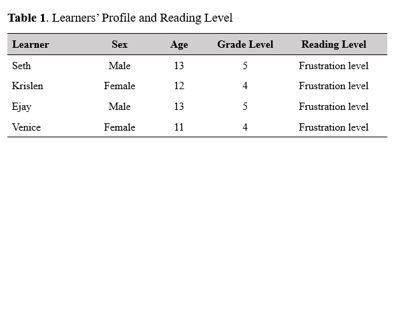
This case study examined four learners to determine the factors contributing to the learners' frustration level and the areas where they struggled with reading skills. The data were gathered through interviews and were analyzed using categorical aggregation to identify significant themes and meanings. The findings revealed that fear and anxiety, limited and unavailability of reading materials, and personalized and guided practice were the contributing factors to the reading skills of frustration-level learners. The difficulty in reading skills of frustration-level learners was building their strong reading foundation, especially in word recognition and syllabication of words, and comprehension of what they read. The cases of Seth, Krislen, Ejay, and Venice showed that several factors shape their reading skills and abilities. The factors that contributed to their reading skills include emotional states such as nervousness, anxiety, fear, hesitation, and physical discomfort. Availability and accessibility of reading materials, appropriate reading approaches, and personalized guidance were also influential factors. It is recommended that creating a positive and supportive learning environment for learners involves providing emotional support, accessible reading materials, personalized instruction, and addressing difficulties in building reading skills.
References
R. A. Grysko and V. I. Zygouris-Coe, “Supporting Disciplinary Literacy and Science Learning in Grades 3–5,” The Reading Teacher, vol. 73, no. 4, August 2019, pp. 485–499, https://doi.org/10.1002/trtr.1860.
Y. Yunidar, “Exploring the Factors that Support Reading Literacy of Elementary School Students in Palu City,” International Journal of Multicultural and Multireligious Understanding, vol. 8, no. 4, 2021, http://dx.doi.org/10.18415/ijmmu.v8i4.2619.
E. Aljaafil, “Critical Thinking Skills for Primary Education: The Case in Lebanon,” Turquoise International Journal of Educational Research and Social Studies, vol. 1, no. 1, November pp. 1–7, https://files.eric.ed.gov/fulltext/ED598279.pdf.
L. M. Blaschke, V. Marin, “Applications of Heutagogy in the Educational Use of E-Portfolios,” Revista de Educación a Distancia (RED), vol. 20, no. 64, September 2020, https://doi.org/10.6018/red.407831.
G. Ladson-Billings, “I’m Here for the Hard Re-Set: Post Pandemic Pedagogy to Preserve Our Culture,” Equity & Excellence in Education, vol. 54, no. 1, February 2021, pp. 68–78, 2021, https://doi.org/10.1080/10665684.2020.1863883.
O. García, J. A. Kleifgen, “Translanguaging and Literacies,” Reading Research Quarterly, vol. 55, no. 4, November 2019, pp. 553–571, https://doi.org/10.1002/rrq.286.
J. Coiro, “Toward a Multifaceted Heuristic of Digital Reading to Inform Assessment, Research, Practice, and Policy,” Reading Research Quarterly, vol. 56, no. 1, February 2020, pp. 9–31, 2021, https://doi.org/10.1002/rrq.302.
T. Alatalo, B. Westlund, “Preschool Teachers’ Perceptions About Read-Alouds as a Means to Support Children’s Early Literacy and Language Development,” Journal of Early Childhood Literacy, vol. 21, no. 3, June 2019, pp. 413–435, https://doi.org/10.1177/1468798419852136.
D. D. Dolean, A. Lervåg, L. Visu-Petra, M. Melby-Lervåg, “Language Skills, and Not Executive Functions, Predict the Development of Reading Comprehension of Early Readers: Evidence from an Orthographically Transparent Language,” Reading and Writing, vol. 34, no. 6, June 2021, pp. 1491–1512, 2021, https://doi.org/10.1007/s11145-020-10107-4.
A. B. I. Bernardo, M. O. Cordel, R. I. G. Lucas, J. M. M. Teves, S. A. Yap, U. C. Chua, “Using Machine Learning Approaches to Explore Non-Cognitive Variables Influencing Reading Proficiency in English Among Filipino Learners,” Education Sciences, vol. 11, no. 10, October 2021, https://doi.org/10.3390/educsci11100628.
A. D. Romero, M. C. Papango, “PISA Reading Literacy Framework vis-a-vis the Philippine K to 12 English Curriculum,” Challenges of PISA: The PNU Report, 2020, p. 33, https://po.pnuresearchportal.org/wp-content/uploads/2021/03/Final-Report-PNU-PISA-Report-Copyrighted-1.pdf#page=36
G. Brooks, J. Clenton, S. Fraser, “Exploring the Importance of Vocabulary for English as an Additional Language Learners’ Reading Comprehension,” Studies in Second Language Learning and Teaching, vol. 11, no. 3, September 2021, pp. 351–376, 2021, https://doi.org/10.14746/ssllt.2021.11.3.3.
G. Momblan, “DEPED: 42,000 Ilonggo Students are ‘Frustrated Readers’,” Iloilo Today, February 2020, https://www.iloilotoday.com/deped-ilonggo-students-frustrated-readers/.
Schools Division of Iloilo, 2021 Reading Assessment Result, 2021 [Report].
I. Ahmad, R. Gul, and M. Zeb, “A Qualitative Inquiry of University Student’s Experiences of Exam Stress and Its Effect on Their Academic Performance,” Human Arenas, vol. 7, April 2022, pp. 778–788, https://doi.org/10.1007/s42087-022-00285-8.
K. M. Cooper, S. E. Brownell, “Student Anxiety and Fear of Negative Evaluation in Active Learning Science Classrooms,” in Active Learning in College Science: The Case for Evidence-Based Practice, J. J. Mintzes and E. M. Walter (Eds), Cham: Springer International Publishing, February 2020, pp. 909–925, https://doi.org/10.1007/978-3-030-33600-4_56.
S. Hood, N. Barrickman, N. Djerdjian, M. Farr, S. Magner, H. Roychowdhury, R. Gerrits, H. Lawford, B. Ott, K. Ross, O. Paige, S. Stowe, M. Jensen, K. Hull, “I Like and Prefer to Work Alone”: Social Anxiety, Academic Self-Efficacy, and Students’ Perceptions of Active Learning,” CBE—Life Sciences Education, vol. 20, no. 1, February 2021, https://doi.org/10.1187/cbe.19-12-0271.
Downloads
Published
Issue
Section
Categories
License
Copyright (c) 2025 Noli B. Ballara, Ma. Xerxa Doan P. Billones-Franco, Joy Mae B. Aquino, Jerlyn Aragon, Merry Joy C. Barillos, Rachel Anne Y. Dris, Janice M. Pineda, Faith Villacote (Author)

This work is licensed under a Creative Commons Attribution-NonCommercial 4.0 International License.