Design and Development of Faculty Evaluation Software for Teaching Effectiveness for SUCs
DOI:
https://doi.org/10.69478/BEST2025v1n2a010Keywords:
Faculty Evaluation Software, Teaching effectiveness, ISO/IEC 25010, UTAUTAbstract
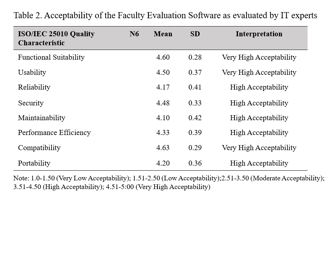
The developed Faculty Evaluation Software demonstrated high effectiveness and acceptability among stakeholders in SUCs. Faculty respondents validated revised teaching effectiveness statements, ensuring alignment with modern pedagogical practices. IT experts rated the software “very highly acceptable” in functional suitability, usability, and compatibility, and “highly acceptable” in other ISO/IEC 25010 attributes. User acceptance evaluation using the UTAUT framework showed strong performance, with supervisors rating the system significantly higher than students in performance expectancy, social influence, and facilitating conditions. These results confirm the software’s potential to modernize faculty evaluation through enhanced accuracy, transparency, and efficiency.
References
A. C. Sinclair, S. A. Gesel, L. M. LeJeune, C. J. Lemons, “A Review of the Evidence for Real-Time Performance Feedback to Improve Instructional Practice,” Journal of Teacher Education, vol. 71, no. 4, September 2019, pp. 431-446, https://doi.org/10.1177/0022466919878470.
Y. Wang, “Quantifying Careless Responses in Student Evaluation of Teaching and Justifying Removal for Data Validity,” SAGE Open, vol. 14, no. 2, May 2024, https://doi.org/10.1177/21582440241256947.
I. T. Plata, J. M. Facun, “Development and Implementation of Web-based Paperless Student Evaluation for Teachers (PSET),” International Journal of Advanced Trends in Computer Science and Engineering, vol. 9, no. 1, January-February 2020, pp. 186-193, https://doi.org/10.30534/ijatcse/2020/28912020.
M. B. Ramos, M. D. A. Paguio, C. A. Collera, C. G. Cruz, “Development and Implementation of A LAN-Based Faculty Performance Appraisal System,” International Journal of Scientific & Technology Research, vol. 9, no. 4, April 2020, pp. 1292-1295, https://doi.org/10.13140/RG.2.2.24443.90406.
I. I. Fadera, J. B. Enriquez, “Intelligent Common Criteria Evaluation and Qualitative Contribution Evaluation for Faculty Members with Data Analytics,” International Journal of Advances in Electronics and Computer Science, vol. 5, no. 6, June 2018, pp. 24-33, https://www.iraj.in/journal/journal_file/journal_pdf/12-477-153396191924-33.pdf.
J. F. Cinizan, H. E. U. Valdez, “Enhanced Faculty Performance Evaluation System with Data Analytics,” E-DAWA: An International Multidisciplinary Research Journal, vol. 3, no. 2, December 2023, pp. 107-118, https://doi.org/10.56901/kxpw6512.
K. M. L. Santillan, “Streamlining Faculty Evaluations: A Web-Based System for Enhanced Efficiency and Data-Driven Insights,” Journal of Innovative Technology Convergence, vol. 6, no. 2, June 2024, pp. 41-48, https://doi.org/10.69478/JITC2024v6n002a04.
P. Vlachogianni, N. Tselios, “Investigating the Impact of Personality Traits on Perceived Usability Evaluation of e-learning Platforms,” Interactive Technology and Smart Education, vol. 19, no. 2, May 2022, pp. 202-221, https://doi.org/10.1108/ITSE-02-2021-0024.
S. Sarwosri, S. Rochimah, U. L. Yuhana, S. B. Hidayat, “Software Quality Measurement for Functional Suitability, Performance Efficiency, and Reliability Characteristics Using Analytical Hierarchy Process,” International Journal on Informatics Visualization, vol. 7, no. 4, December 2023, pp. 2421–2426, http://dx.doi.org/10.62527/joiv.7.4.2441.
S. Purkayastha, S. Goyal, B. Oluwalade, T. Phillips, H. Wu, X. Zou, “Usability and Security of Different Authentication Methods for an Electronic Health Records System,” arXiv. February 2021, https://doi.org/10.48550/arXiv.2102.11849.
M. S. Rahman, S. M. Shuhidan, M. N. Masrek, “The Influence between GIS Quality and user Satisfaction towards Individual Work Performance: A Proposed Conceptual Framework,” International Journal of Emerging Technology and Advanced Engineering, vol. 11, no. 12, December 2021, pp. 164-170, https://doi.org/10.46338/ijetae1221_17.
R. S. Marwah, B. K. Gupta, “Understanding Technology Acceptance in Higher Education Institutions: A Comparative Study of Teacher and Student Perspectives in Lucknow,” Educational Administration: Theory and Practice, vol. 30, no. 10, 2024, pp. 330-338, https://doi.org/10.53555/kuey.v30i10.8138.
N. B. Malatsico, F. E. L. Manayan, “Factors Leading to the Acceptance of Management Information System in Public Schools: A Path Analysis,” International Journal of Innovative Science and Research Technology, vol. 9, no. 3, March 2024, https://doi.org/10.38124/ijisrt/IJISRT24MAR269.
K. Fuchs, “Using an Extended Technology Acceptance Model to Determine Students’ Behavioral Intentions Toward Smartphone Technology in the Classroom,” Frontiers in Education, vol. 7, September 2022, https://doi.org/10.3389/feduc.2022.972338.
R. A. Salva, L. O. Cadavedo, S. V. O. Cadavedo, K. T. Patinga, “Technology-Assisted and In-Person Supervisory Challenges in Philippine Public Schools: A Comparative Analysis,” The New Educational Review, vol. 72, no. 2, January 2023, pp. 148-158. https://doi.org/10.15804/tner.23.72.2.11.
E. Yuliantie, “The Effect of Performance Expectancy on Behavioral Intention: The Mediating Role of Satisfaction,” Journal of Management and Business Insight, vol. 2, no. 1, December 2024, pp. 80-89, https://doi.org/10.12928/jombi.v2i1.1123.
D. Joshi, S. M. Zalte, Sridhar, R. K. Johny, D. A. Mahajan, “The Impact of Blended Learning on Student Engagement in the Digital Era,” European Chemical Bulletin, vol. 12, no. SI-12, June 2023, pp. 727-735, https://doi.org/10.48047/ecb/2023.12.si12.063.
A. H. S. Al-Azawei, “Modelling E-Learning Adoption: The Influence of Learning Style and Universal Learning Theories,” PhD Thesis, University of Babylon, Iraq, December 2016.
S. Barikzai, S. V. Bharathi, A. Perdana, “Challenges and Strategies in e-learning Adoption in Emerging Economies: A Scoping Review,” Cogent Education, vol. 11, no. 1, September 2024, https://doi.org/10.1080/2331186X.2024.2400415.
V. Venkatesh, M. G. Morris, G. B. Davis, F. D. Davis, “User Acceptance of Information Technology: Toward a Unified View,” MIS Quarterly, vol. 27, no. 3, September 2003, pp. 425-478, https://doi.org/10.2307/30036540.
Downloads
Published
Issue
Section
Categories
License
Copyright (c) 2025 Rene D. Arduo, Felicisimo V. Wenceslao, Jr. (Author)

This work is licensed under a Creative Commons Attribution-NonCommercial 4.0 International License.