Motivation, Commitment and Job Satisfaction: It’s Influence on Faculty Performance in the Work From Home (WFH) Perspective
DOI:
https://doi.org/10.69478/BEST2025v1n1a005Abstract
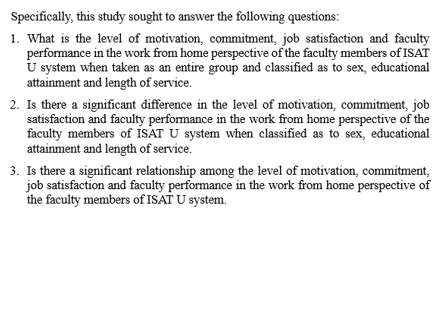
This descriptive study investigated the influence of motivation, commitment and job satisfaction on faculty performance in the Work from Home (WFH) perspective of ISAT U faculty members. The participants of this study were the two hundred seventeen (217) regular and part-time faculty members of ISAT U System, AY 2021-2022. Random sampling technique was used in selecting the samples to ensure a fair representation of the target population. The sample size was determined using Slovin’s Formula. The researcher-made instrument using remote data gathering method (google form) and face to face gathering of data was utilized to collect the data. The instrument was subjected to content validation with the three experts. The study revealed that the faculty members were extremely motivated, extremely committed, extremely satisfied in their jobs and had very satisfactory teaching performance in the work from home perspective. A significant relationship was observed between motivation and commitment, between motivation and job satisfaction, and between commitment and job satisfaction in the work from home perspective of faculty members. Finally, no significant relationship was observed between motivation and teaching performance, between commitment and teaching performance, and between job satisfaction and teaching performance in the work from home perspective of faculty members.
References
M. Dawkins, “Benefits of Working from Home (Working Remotely),” FlexJobs, November 2024, https://www.flexjobs.com/blog/post/benefits-of-remote-work/.
N. F. M. Zamani, M. H. M. Ghani, S. F. M. Radzi, N. H. Rahmat, N. S. A. Kadar, A. A. R. Azram, “A Study of Work from Home Motivation among Employees,” International Journal of Asian Social Science, vol. 11, no. 8, August 2021, pp. 388-398, https://doi.org/10.18488/journal.1.2021.118.388.398.
R. Palumbo, “Let Me Go to the Office! An Investigation into the Side Effects of Working from Home on Work-Life Balance,” International Journal of Public Sector Management, vol. 33, no. 6-7, October 2020, pp. 771-790, https://doi.org/10.1108/IJPSM-06-2020-0150.
A. A. Davidescu, S. A. Apostu, A. Paul, I. Casuneanu, “Work Flexibility, Job Satisfaction, and Job Performance Among Romanian Employees - Implications for Sustainable Human Resource Management,” Sustainability, vol. 12, no. 15, July 2020, https://doi.org/10.3390/su12156086.
M. Dindar, A. Suorsa, J. Hermes, P. Karppinen, P. Näykki, “Comparing Technology Acceptance of K-12 Teachers with and without Prior Experience of Learning Management Systems: A Covid-19 Pandemic Study,” Journal of Computer Assisted Learning, vol. 37, no. 6, August 2021, pp. 1553-1565, https://doi.org/10.1111/jcal.12552.
I. Bakan, T. Buyukbese, B. Ersahan, B. Sezer, “Effects of Job Satisfaction on Job Performance and Occupational Commitment,” International Journal of Management & Information Technology, vol. 9, no. 1, March 2014, pp. 1472-1480, https://doi.org/10.24297/ijmit.v9i1.668.
Downloads
Published
Issue
Section
Categories
License
Copyright (c) 2025 Nilde S. Alderete (Author)

This work is licensed under a Creative Commons Attribution-NonCommercial 4.0 International License.