Teaching Styles, Students’ Motivation, and Grit as Correlates of Students’ Performance in English
DOI:
https://doi.org/10.69478/BEST2025v1n1a006Keywords:
Grit, Motivation to learn English, Students’ performance in English, Teaching stylesAbstract
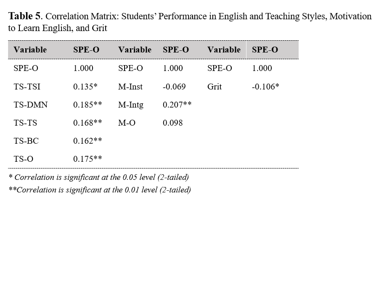
This study was conducted to examine the relationship between students' English performance and the following constructs: teaching styles, teachers' leadership behavior, students' motivation to learn English, and students' level of grit. The statistical tools used in this descriptive research study were frequency analysis, mean computation, and correlation analysis. The performance of students in English is categorized as moderately proficient. As perceived by the students, the teachers frequently exhibit the four dimensions of teaching style. The findings reveal that the students are more integratively motivated than instrumentally; on average, they have a moderate level of grit. All constructs in this study show significant correlations with students' English performance, except for instrumental motivation. The significant correlation between students' performance in English and teaching style and integrative motivation is positive, but with grit, it is negative.
References
D. M. Abello, J. Alonso-Tapia, E. Panadero, “Development and Validation of the Teaching Styles Inventory for Higher Education (TSIHE),” Anales de Psicologia, vol. 36, no. 1, April 2020, pp. 143-154, https://dx.doi.org/10.6018/analesps.36.1.370661.
A. A. A. B. Karo, S. N. Tarigan, T. A. Simanjuntak, “Study of the Influence of Teachers’ Teaching Style on Students’ Interest in Learning English,” International Journal of Scientific Multidisciplinary Research, vol. 2., no. 8, August 2024, pp. 905-916, https://doi.org/10.55927/ijsmr.v2i8.10627.
R. C. Gardner, “Motivation and Second Language Acquisition. The Socio Educational Model,” New York, USA: Peter Lang Publishing, Inc., 2010.
A. L Duckworth, P. D. Quinn, “Development and Validation of the Short Grit Scale (Grit-S),” Journal of Personality Assessment, vol. 91, no. 2, March 2009, pp. 166-174, https://doi.org/10.1080/00223890802634290.
A. F. Hayes, “Introduction to Mediation, Moderation, and Conditional Process Analysis: A Regression-Based Approach,” 3rd ed., NY, USA: Guilford Press, 2022.
S. Wisnuwardhani, “Influence of Instrumental Motivation and Integrative Motivation on English Learning Outcomes,” International Journal of Ethno-Sciences and Education Research, vol. 2, no. 1, January 2022, pp. 19-24, https://doi.org/10.46336/ijeer.v2i1.235.
Y. Wu, L. Foong, N. Alias, “Motivation and Grit Affects Undergraduate Students’ English Language Performance,” European Journal of Education Research, vol. 11, no. 2, April 2022, pp. 781-794, https://doi.org/10.12973/eu-jer.11.2.781.
Downloads
Published
Issue
Section
Categories
License
Copyright (c) 2025 Massuline Antonio D. Ligaya, Marie Charmaine P. Igwe (Author)

This work is licensed under a Creative Commons Attribution-NonCommercial 4.0 International License.