Tales of Sibalom River for a Culturally-Responsive Teaching in Early Childhood Education
DOI:
https://doi.org/10.69478/BEST2025v1n1a014Keywords:
Cultural Narratives, Local Knowledge, Sibalom River, Cultural Responsive TeachingAbstract
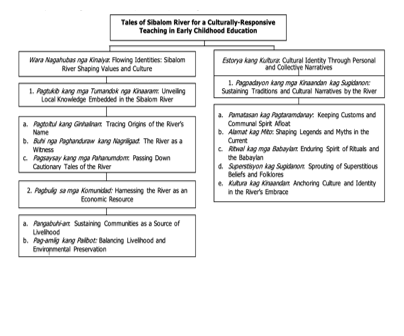
Rivers have long been integral to the identity and cultural development of communities, shaping traditions, beliefs, and ways of life. This study explores the cultural narratives and local knowledge associated with the Sibalom River, aiming to uncover its role in shaping values, traditions, and livelihoods within the community ensuring that indigenous knowledge and historical narratives are meaningfully integrated into education. A qualitative research approach was employed, utilizing in-depth interviews, participant observations, field notes, and photographic documentation to capture the rich cultural and historical significance of the Sibalom River. Through thematic analysis, key patterns and insights emerged, reflecting the deep connection between the river and the lives of the people who depend on it. The findings of this study reveal that the Sibalom River is not just a body of water but a keeper of the community’s history and identity. Through the stories, beliefs, and customs passed down along its banks, the river continues to shape the values, traditions, and everyday lives of the people who call it home. From these insights, the study brings forward two important ideas: Flowing Identities, which captures how the river shapes the way people live and the values they hold, and Anchored in Story, which reminds us how shared narratives help preserve cultural identity and strengthen the bonds within the community. These ideas offer meaningful ways for schools and local groups to include local culture in learning and community activities, making sure these stories and values live on. By recognizing the Sibalom River as a cultural and educational resource, educators and curriculum developers may create meaningful learning experiences that strengthen community identity and environmental stewardship while fostering a deeper appreciation for local heritage.
References
H. J. Funtecha, “A History of Panay,” Rex Book Store, 2006.
National Commission for Culture and the Arts, “Cultural Mapping Toolkit: A Guide for Participatory Cultural Mapping in Local Communities,” 2019, https://ncca.gov.ph/wp-content/uploads/2020/08/WebPosting_Cultural-Mapping-Toolkit.pdf.
E. S. Akinmolayan, C. A. Hingston, U. J. Akpan, O. A. Arise, “Towards Decolonization of Primary School Education in South Africa,” African Journal of Childhood Education, vol. 14, no. 1, June 2024, pp. 1-10, https://doi.org/10.4102/sajce.v14i1.1440.
J. D. Pregoner, R. Leopardas, D. Marzado, K. Retherford, I. J. Ganancial, F. Sedo, “Indigenous Storytelling Practices and Communicative Competence of Urban Learners from Philippine Ethnolinguistic Groups,” IMCC Journal of Education, vol. 4, no. 2, December 2024, pp. 1-8, https://myjournal.imcc.edu.ph/wp-content/uploads/2024/12/Pregoner-et-al-2024.pdf.
E. A. Navas, C. E. Calinggan, J. J. G. Roete, E. B. Siyang, A. J. Leano, “A Proposed Indigenous Peoples Teacher Education Curriculum Framework: Focused on Some Attributes of Beginning Teachers of Indigenous Peoples in the Philippines,” Asian Journal on Perspectives in Education, vol. 4, no. 1, November 2023, pp. 17-31, https://doi.org/10.63529/ajpe.v4i1.8481.
R. Sales-Batang, M. Jaafar, J. Domingo-Alejo, M. Ramirez, F. A. Varona, J. Saquing, “Cultivating Intercultural Competence through Culturally Grounded Pedagogy: A Cultural Studies Perspective in Philippine Higher Education Institutions,” International Journal on Culture, History, and Religion, vol. 7, no. SI2, July 2025, pp. 735-750, https://doi.org/10.63931/ijchr.v7iSI2.241.
L. S. Nowell, J. M. Norris, D. E. White, N. J. Moules, “Thematic Analysis: Striving to Meet the Trustworthiness Criteria,” International Journal of Qualitative Methods, vol. 16, no. 1, October 2017, pp. 1-13, https://doi.org/10.1177/1609406917733847
B. Maharjan, N. K. Manandhar, B. P. Pant, N. Dahal, (2024). “Meaningful Engagement of Preschoolers through Storytelling Pedagogy,” Pedagogical Research, vol. 9, no. 2, 2024, pp. 1-8, https://doi.org/10.29333/pr/14144.
M. Saunders, P. Lewis, A. Thornhill, “Research Methods for Business Students,” 6th ed., Pearson Education Limited, 2019, ISBN: 978-1-292-20878-7.
Downloads
Published
Issue
Section
Categories
License
Copyright (c) 2025 Christpeter F. Omayana (Author)

This work is licensed under a Creative Commons Attribution-NonCommercial 4.0 International License.