The Creative Hand Weavers of Antique: An Ethnographic Case Study
DOI:
https://doi.org/10.69478/BEST2025v1n1a033Keywords:
Handloom Weavers, Weaving, Handicrafts, Ethnography, Case studyAbstract
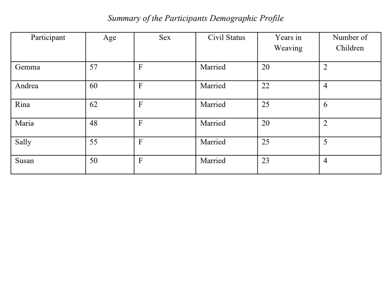
This research seeks to explore the stories behind the weavers of Antique, determine the meanings and value attached to their products and how do the weavers define the challenges and opportunities of loom weaving in Antique, specifically in the municipalities of Bugasong and Tibiao, Antique. Using a qualitative ethnographic case study, visiting sites and reading/reviewing articles, in-depth interviews, participant observation were conducted with experiences weavers in Antique. Thematic analysis revealed nine (9) key themes: (1) Weaving as a Family Tradition, (2) Weaving as a Source of Income and Economic Development, (3) Weaving for Women Empowerment and Gender Equality, (4) Woven Products as a representation of Cultural Identity and Tradition, (5) Woven Products as a Symbol of Community and Social Connection, (6) A. The Struggle to Compete with the Global market Trends, (7) Difficulty of Achieving Economic Stability, (8) Cultural Revitalization and Preservation and (9) Artistic Expression, Innovation and Creativity. These themes illustrate the stories of the weavers. The woven products that represent one's cultural identity and respect, strengthening community bonds through shared craftsmanship as evidenced by its participation in national and international scene. However, weavers faced challenges in the modern times such as to revitalize and preserve traditional weaving practices and cultural heritage. To address these concerns this study recommends that the government should strengthen and augment its various schemes and programs designed to address challenges like competition, marketing, infrastructure, and credit access.
References
L. Legarda, “Legarda Continues to Boost Antique Weaving Traditions, Encourages Local Government to Support Weaving Communities,” September 2020, https://lorenlegarda.com.ph/legarda-continues-to-boost-antique-weaving-traditions-encourages-local-government-to-support-weaving-communities/.
Daily Guardian, “More Weaving Centers in Antique,” September 2020, https://dailyguardian.com.ph/more-weaving-centers-in-antique/.
L. Yang, L. Qi, B. Zhang, “Concepts and Evaluation of Saturation in Qualitative Research,” Advances in Psychological Science, vol. 30, no. 3, July 2022, pp. 511-521, https://doi.org/10.3724/SP.J.1042.2022.00511.
S. C. Amornkitt, C. Bussracumpakorn, “Cultural Knowledge Transfer of the Inherited Karen Backstrap Weaving for the 4th Generation of a Pwo Karen Community,” 2023, https://kirim.kmutt.ac.th/converis/portal/detail/Publication/1469763042?lang=en_GB.
R. M. Dias, J. P. Ogle, S. Diddi, “Constructing Cultural Identity Through Weaving Among Ri-Bhoi Women Weavers: A Symbolic Interactionist Approach,” Fashion and Textiles, vol. 7, September 2020, https://doi.org/10.1186/s40691-020-00220-x.
G. S. Brogan, K. E. Dooley, “Weaving Together Social Capital to Empower Women Artisan Entrepreneurs,” International Journal of Gender and Entrepreneurship, vol. 16, no. 1, October 2023, pp. 69-88, https://doi.org/10.1108/IJGE-03-2023-0076.
C. Nugroho, I. K. Nurhayati, K. Nasionalita, R. M. U. Malau, “Weaving and Cultural Identity of Batak Toba Women,” Journal of Asian and African Studies, vol. 56, no. 6, September 2020, https://doi.org/10.1177/0021909620958032.
A. E. Maynard, P. M. Greenfield, C. P. Childs, M. Weinstock, “Social Change, Cultural Evolution, Weaving Apprenticeship, and Development: Informal Education Across Three Generations and 42 years in a Maya Community,” Applied Developmental Science, vol. 28, no. 1, April 2023, pp. 82-105, https://doi.org/10.1080/10888691.2022.2151445.
D. Wongsawangsiri, T. Wechkama, “Integration of Concepts for the Learning Process of Textile Weaving at Lan Khoi Village, Phatthalung Province, Thailand,” International Journal of Education and Literacy Studies, vol. 12, no. 1, January 2024, pp. 140-147, http://dx.doi.org/10.7575/aiac.ijels.v.12n.1p.140.
Downloads
Published
Issue
Section
Categories
License
Copyright (c) 2025 Julie A. Zulueta, Kendra Mae S. Anastacio (Author)

This work is licensed under a Creative Commons Attribution-NonCommercial 4.0 International License.