Sign-Bridge: A Dual Sign Language Translator App for Enhanced Communication and Inclusivity
DOI:
https://doi.org/10.69478/BEST2025v1n2a014Keywords:
Filipino Sign Language, Assistive Technology, Deep Learning, InclusivityAbstract
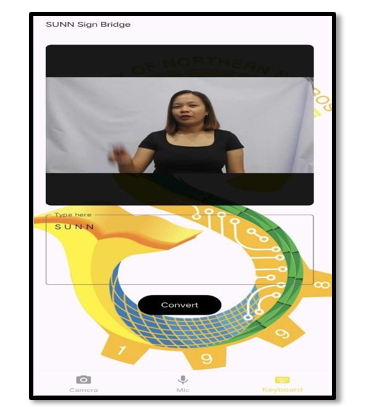
This study presents the development of Sign-Bridge, a dual-mode mobile application to enhance communication accessibility for Deaf students enrolled in the university by supporting Filipino Sign Language (FSL). Unlike most existing solutions that default to American Sign Language (ASL), this app is purpose-built for FSL, reflecting local linguistic and cultural context. Employing a developmental research framework and the Agile Software Development Life Cycle (SDLC), the system was engineered using Android Studio, Flutter, Node.js, Teachable Machine, and TensorFlow Lite. The Sign-Bridge app features two-way translation: it converts spoken and written text into FSL gestures through deep learning-based recognition and translates FSL signs into text. The evaluation involved 12 purposively selected participants: five IT experts who assessed system performance and maintainability, one content expert who validated linguistic accuracy, and six Deaf students who evaluated its usability. McCall’s Software Quality Model concluded the expert assessments, while the Technology Acceptance Model (TAM) guided user feedback. The system achieved 100% accuracy in text-to-sign and audio-to-sign translation, and 90% accuracy in sign-to-text recognition. Expert evaluators gave an average rating of 4.39 (Good), while users rated the app 4.18 (Agree), indicating a high level of technical soundness and user satisfaction. These results demonstrate the Sign Bridge app’s strong potential as an inclusive educational and communication tool, contributing meaningfully to accessible technology development for the Deaf in the Philippine context.
References
Republic Act No. 11106, “The Filipino Sign Language Act,” 17th Congress of the Republic of the Philippines, 2018, https://www.officialgazette.gov.ph/2018/10/30/republic-act-no-11106/.
R. Lal, “Develop Sign Language App Like Lingvano: Cost & Feature,” Idea Usher, September 2024, https://ideausher.com/blog/develop-sign-language-app-like-lingvano/.
B. Ong, “FSL buddy,” AppAdvice, https://appadvice.com/app/fsl-buddy/1372650469.
L. U. Velasco, R. S. Macatangga, C. P. Pepito, M. G. Chua, E. G. Galupo, M. J. R. Del Mundio, E. L. Dilla, “Sign for EveryJUAN: An Interactive Android Application that Teaches Filipino Sign Language Using Hand Gesture Recognition,” in Proceedings of 5th Borobudur International Symposium on Humanities and Social Science (BISHSS 2023), Advances in Social Science, Education and Humanities Research, vol. 856, August 2024, pp. 504-513, https://doi.org/10.2991/978-2-38476-273-6_55.
M. D. Montefalcon, J. R. Padilla, R. L. Rodriguez, “Filipino Sign Language Recognition Using Deep Learning Techniques,” in Proceedings of 2021 5th International Conference on E-Society, E-Education and E-Technology, December 2021, pp. 219-225, https://doi.org/10.1145/3485768.348578.
B. Sanjeevkumar, S. P. Varun, S. Y. Babu, “Assessing Google’s Teachable Machine by Deploying American Sign Language Detection System,” International Journal for Multidisciplinary Research, vol. 7, no. 2, March-April 2025, pp. 45–52, https://doi.org/10.36948/ijfmr.2025.v07i02.40745.
A. A. Putra, “TensorFlow Lite: Revolutionizing AI on Edge Devices,” Medium, June 2023, https://ai.plainenglish.io/tensorflow-lite-revolutionizing-ai-on-edge-devices-9d814cd0c350.
J. A. McCall, P. K. Richards, G. F. Walters, “Factors in Software Quality: Concept and Definitions of Software Quality,” Final Technical Report, U.S. Rome Air Development Center, November 1977, https://apps.dtic.mil/sti/citations/ADA049014.
F. D. Davis, “Perceived Usefulness, Perceived Ease of Use, and User Acceptance of Information Technology,” MIS Quarterly, vol. 13, no. 3, September 1989, pp. 319–340, https://doi.org/10.2307/249008.
L. Goyal, V. Goyal, “Text to Sign Language Translation System: A Review of Literature,” International Journal of Synthetic Emotions, vol. 7, no. 2, June 2016, pp. 62–77. https://doi.org/10.4018/IJSE.2016070104.
Downloads
Published
Issue
Section
Categories
License
Copyright (c) 2025 Kristine T. Soberano (Author)

This work is licensed under a Creative Commons Attribution-NonCommercial 4.0 International License.