Evaluation of Christian Values-Integrated Language Arts Instructional Material
DOI:
https://doi.org/10.69478/BEST2025v1n1a011Keywords:
Evaluation, Values, Instructional materialAbstract
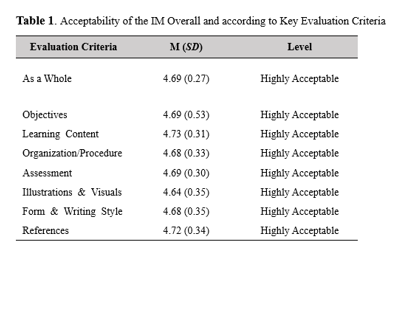
This study evaluated the acceptability of a Christian values-integrated language arts instructional material to assess its quality, alignment with educational standards, and potential for integrating character-building into academic instruction. Employing a mixed-methods research design, both quantitative and qualitative data were collected from English educators, ministers, students, and parents to ensure a comprehensive evaluation. Findings from the quantitative phase indicated that the instructional material was highly acceptable across key criteria, including objectives, learning content, organization and procedure, assessment, illustrations and visuals, form and writing style, and references. Among these, learning content and references received the most favorable feedback, reflecting strong alignment with academic goals and moral values. In contrast, illustrations and visuals received relatively lower approval, suggesting an area for potential enhancement. Qualitative feedback reinforced these results, highlighting the material’s clear structure, effective integration of Christian values, and alignment with academic standards. Respondents commended its role in deepening students’ faith and moral understanding, while also pointing out recurring areas for improvement. In conclusion, the instructional material shows strong promise as an effective tool for promoting both academic achievement and moral development. Further enhancements in visual design, interactivity, and inclusivity could significantly strengthen its impact and relevance across diverse learning communities. Recommendations included incorporating more engaging visuals, interactive features, and refining the layout and design for better accessibility. Additionally, participants emphasized the need for a more inclusive approach that respects diverse beliefs and learning needs.
References
S. El-Ton-Chalcraft, P. J. Cammack, “Christian Values in Education: Teachers in India Narrate the Impact of Their Faith and Values on Practice,” Journal of Beliefs & Values, vol. 41, no. 3, August 2019, pp. 284-304, https://doi.org/10.1080/13617672.2019.1647674.
M. A. Jufang, “Research on Integrating Moral Education into College English Course on the Basis of Outcomes-Based Teaching Mode,” Psychology Research, vol. 12, no. 10, October 2022, pp. 865-873, https://doi.org/10.17265/2159-5542/2022.10.012.
M. B. Gainau, B. S. Gainau, “The Application of Module Learning Strategies by Christian Religion Education Teachers Towards Students' Learning Achievement During COVID- 19,” Journal of Positive School Psychology, vol. 6, no. 9, 2022, pp. 1166-1171, https://journalppw.com/index.php/jpsp/article/view/12386/8032.
L. Zhan, “Integration of Ideological and Political Education into College English Teaching,” International Journal of New Developments in Education, vol. 5, no. 21, 2023, pp. 140-145, https://doi.org/10.25236/IJNDE.2023.052125.
C. D. Safitri, B. Jabu, S. Samtidar, “The Integration of Islamic Values in English Language Teaching Context: Practices and Challenges,” Celebes Journal of Language Studies, vol. 3, no. 2, December 2023, pp. 315-324, https://doi.org/10.51629/cjls.v3i2.156.
L. Wang, A. Abd Samad, N. S. M. Abdullah, “The Development of College English Teachers’ Pedagogical Content Knowledge in Moral Education Integrated College English Teaching in China,” Pertanika Journal of Social Science & Humanities, vol. 32, no. 3, September 2024, pp. 1201-1218, https://doi.org/10.47836/pjssh.32.3.19.
S. Kullmann, “Teaching Counts! Open Educational Resources as an Object of Measurement for Scientometric Analysis,” Quantitative Science Studies, vol. 6, no. 1, March 2025, pp. 216-237, https://doi.org/10.1162/qss_a_00346.
M. B. Sholeh, N. Ahsin, Z. Alany, F. Fatimah, “The Integration of Religious Moderation Values in English Language Teaching in Madrasah,” in the Proceedings of the International Conference on Madrasah Reform 2021 (ICMR 2021), Advances in Social Science, Education and Humanities Research, vol. 633, January 2022, https://doi.org/10.2991/assehr.k.220104.027.
S. A. Sakti, S. Endraswara, A. Rohman, “Integrating Local Cultural Values into Early Childhood Education to Promote Character Building,” International Journal of Learning, Teaching and Educational Research, vol. 23, no. 7, July 2024, pp. 84-101, https://doi.org/10.26803/ijlter.23.7.5.
I. D. Nurrohmah, D. Puspitasari, F. N. Mukaromah, “Fostering religious moderation: Integrating values into the English language teaching classroom,” Kodifikasia: Jurnal Penelitian Islam, vol. 18, no. 1, June 2024, pp. 70-85, https://doi.org/10.21154/kodifikasia.v18i1.9539.
Downloads
Published
Issue
Section
Categories
License
Copyright (c) 2025 Shirley D. Frigillano (Author)

This work is licensed under a Creative Commons Attribution-NonCommercial 4.0 International License.