Modeling Faculty Acceptance of LMS: A PLS-SEM Validation of the Technology Acceptance Model in Philippine Higher Education
DOI:
https://doi.org/10.69478/BEST2025v1n1a016Keywords:
Faculty, Learning Management System, PLS-SEM, Technology Acceptance ModelAbstract
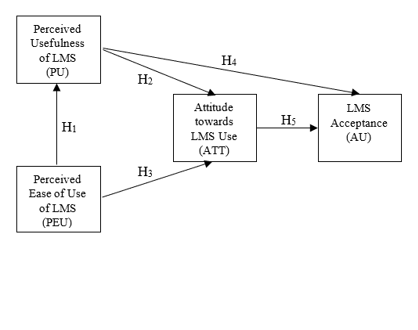
This study investigates the structural relationships among perceived ease of use, perceived usefulness, attitude toward use, and acceptance of Learning Management Systems (LMS) among faculty members in Philippine higher education. Grounded in the Technology Acceptance Model (TAM) and validated through Partial Least Squares Structural Equation Modeling (PLS-SEM), the study surveyed 306 faculty from selected State Universities and Colleges (SUCs) in Leyte and Biliran. Results revealed that perceived ease of use significantly influenced both perceived usefulness and attitude toward LMS use, while perceived usefulness had a strong positive effect on both attitude and LMS acceptance. Additionally, attitude toward LMS use emerged as the most substantial predictor of actual LMS acceptance. The measurement model demonstrated strong reliability and validity, and the structural model indicated high explanatory power and predictive relevance. These findings affirm the applicability of TAM in the Philippine academic context and highlight the critical role of faculty attitudes in driving successful LMS adoption. The study recommends institutional strategies that enhance system usability, provide targeted training, and cultivate positive faculty attitudes to support sustainable digital transformation in higher education.
References
A. Singun, “Unveiling the Barriers to Digital Transformation in Higher Education Institutions: A Systematic Literature Review,” Discover Education, vol.4, no. 37, February 2025, https://doi.org/10.1007/s44217-025-00430-9.
J. Quiban, “Faculty Acceptance and Adoption of Learning Management Systems (LMS) using the Extended Technology Acceptance Model (ETAM)”, Journal of Innovative Technology Convergence, vol. 6, no. 1, April 2024, pp. 1-4, https://doi.org/10.69478/JITC2024v6n2a01.
M. Al-Nauimi, M. Al-Emran, “Learning Management Systems and Technology Acceptance Models: A Systematic Review,” Education and Information Technologies April 2021, pp. 5499-5533, https://doi.org/10.1007/s10639-021-10513-3.
F. Davis, “Perceived Usefulness, Perceived Ease of Use, and User Acceptance of Information Technology” MIS Quarterly, vol. 13, no. 3, September 1989, pp. 319-340, https://doi.org/10.2307/249008.
J. T. Amora, “On the Validity Assessment of Formative Measurement Models in PLS-SEM,” Data Analysis Perspectives Journal, vol. 4, no. 2, May 2023, pp. 1-7, https://scriptwarp.com/dapj/2023_DAPJ_4_2/Amora_2023_DAPJ_4_2_FormativeAssessment.pdf.
J. T. Amora, “Convergent Validity Assessment in PLS-SEM: A Loadings-Driven Approach,” Data Analysis Perspectives Journal, vol. 2, no. 3, June 2021, pp. 1-6, https://scriptwarp.com/dapj/2021_DAPJ_2_3/Amora_2021_DAPJ_2_3_ConvergentValidity.pdf.
N. Kock, “Using Causality Assessment Indices in PLS-SEM,” Data Analysis Perspectives Journal, vol. 3, no. 5, June 2022b, pp. 1-6, https://scriptwarp.com/dapj/2022_DAPJ_3_5/Kock_2022_DAPJ_3_5_CausalityAssessment.pdf.
C. Fornell, D. Larcker, “Evaluating Structural Equation Models with Unobservable Variables and Measurement Error,” Journal of marketing research, vol. 18, no. 1, 1981, pp. 39-50, https://doi.org/10.2307/3151312.
E. Roemer, F. Schuberth, J. Henseler, “HTMT2–An Improved Criterion for Assessing Discriminant Validity in Structural Equation Modeling,” Industrial management & data systems, vol. 121, no. 12, 2021, pp.2637-2650, https://doi.org/10.1108/IMDS-02-2021-0082.
N. Kock, “Common Method Bias in PLS-SEM: A Full Collinearity Assessment Approach,” International Journal of e-Collaboration (ijec), vol. 11, no. 4, October 2015, pp.1-10, https://doi.org/10.4018/ijec.2015100101.
N. Kock, “Using Logistic Regression in PLS-SEM: Dichotomous Endogenous Variables,” Data Analysis Perspectives Journal, vol.4, no. 4, October 2023, pp.1-6, DOI: https://scriptwarp.com/dapj/2023_DAPJ_4_4/Kock_2023_DAPJ_4_4_LogRegrDichotEndog.pdf.
R. L. Cohen, “Memory for Action Events: The Power of Enactment,” Educational psychology review, volume 1, 1989, pp. 57-80, https://www.jstor.org/stable/23359364.
Downloads
Published
Issue
Section
Categories
License
Copyright (c) 2025 Josie B. Quiban (Author)

This work is licensed under a Creative Commons Attribution-NonCommercial 4.0 International License.