Difficulties Encountered in Teaching Qualitative Research Method Among Senior High School Teachers: Basis for Enhancement Activity for Extension
DOI:
https://doi.org/10.69478/BEST2025v1n1a019Keywords:
Difficulties encountered, Qualitative research method, SHS teachers, Enhancement activityAbstract
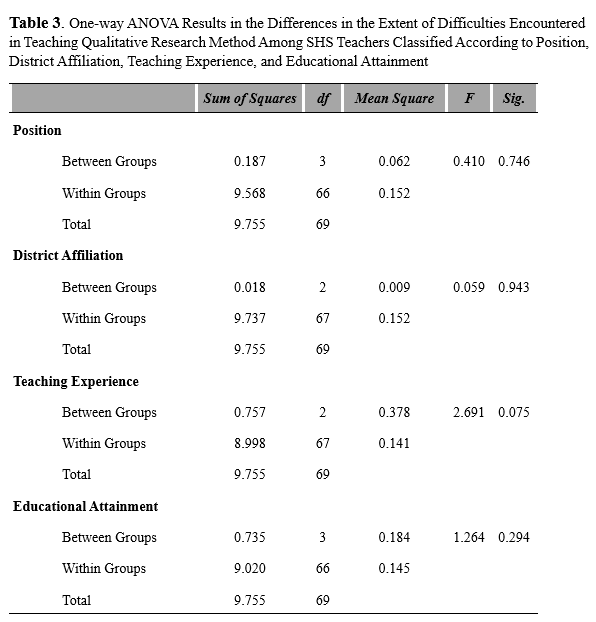
This descriptive study explored the challenges faced by Senior High School (SHS) teachers in teaching qualitative research in the province of Antique during Academic Year 2023–2024. The respondents were 70 identified public SHS teachers assigned to teach Practical Research 1 (Qualitative Research). A researcher-made and validated instrument was utilized for data collection. Descriptive statistics included frequency, percentage, rank, and mean, while inferential statistics employed was One-way ANOVA set at a 0.05 alpha level. Findings revealed that the majority of SHS teachers teaching qualitative research were Teacher II as to rank, resided in the northern part of Antique, had limited teaching experience, and held a bachelor's degree. The top five difficulties encountered in teaching qualitative research method rated as "High were: (1) lack of knowledge in using NVivo for data analysis, (2) lack of knowledge in using Atlas.ti, (3) limited access to accredited evaluators or reviewers, (4) limited access to accredited publications, and (5) limited access to accredited refereed journals. No significant differences were found in the extent of difficulties encountered when teachers were grouped according to their demographic profile.
References
S. Bako, “University, Research, Development in Nigeria: Time for a Paradigmatic Shift,” in the Proceedings of 11th General Assembly of CODESRIA on Rethinking African Development: Beyond Impasse: Towards Alternatives, Maputo, Mozambique, 2005, https://www.iese.ac.mz/lib/PPI/IESE-PPI/pastas/governacao/educacao/artigos_cientificos_imprensa/fd_183.pdf.
J. W. Creswell, “Educational Research: Planning, Conducting and Evaluating Quantitative and Qualitative Research (4th ed.),” Boston, MA, USA: Pearson/Merrill Prentice Hall, 2012, ISBN: 978-0-13-136739-5.
L. Rioja, “School Administrators’ Readiness and Productivity in Research: Basis for Capability Building Program,” Unpublished Doctoral Dissertation, University of Antique, Philippines, 2016.
Republic of the Philippines, “Republic Act No. 9155: An Act Instituting a Framework of Governance for Basic Education, Establishing Authority and Accountability, Renaming the Department of Education, Culture and Sports as the Department of Education, and for Other Purposes”, August 2001, https://lawphil.net/statutes/repacts/ra2001/ra_9155_2001.html.
Department of Education, “DepEd Order No. 24, s. 2010: Basic Education Research Fund,” March 2010, https://www.deped.gov.ph/2010/03/08/do-24-s-2010-basic-education-research-fund/.
Department of Education, “DepEd Order No. 13, s. 2015: Establishment of a Policy Development Process at the Department of Education,” April 2015, https://www.deped.gov.ph/2015/04/13/do-13-s-2015-establishment-of-a-policy-development-process-at-the-department-of-education/.
Department of Education, “DepEd Order No. 43, s. 2015: Revised Guidelines for the Basic Education Research Fund (BERF),” September 2015, https://www.deped.gov.ph/2015/09/16/do-43-s-2015-revised-guidelines-for-the-basic-education-research-fund-berf/.
F. Wang, “Challenges of Learning to Write Qualitative Research: Students' Voices,” International Journal of Qualitative Methods, vol. 12, no. 1, February 2013, pp. 638-651, https://doi.org/10.1177/160940691301200134.
S. Li, C. Searle, “Learning to Do Qualitative Data Analysis: An Observational Study of Doctoral Work,” Qualitative Health Research, vol. 17, no. 10, December 2007, pp. 1442-1452, https://doi.org/ 10.1177/1049732307306924.
D. Belcher, A. Hirvela, “Writing the qualitative dissertation: What motivates and sustains commitment to a fuzzy genre?,” Journal of English for Academic Purposes, vol. 4, no. 3, July 2005, pp. 187-205, https://doi.org/10.1016/j.jeap.2004.07.010.
M. Ely, M. Anzul, T. Friedman, D. Garner, A. M. Steinmetz, “Doing Qualitative Research: Circles Within Circles,” The Falmer Press: London, UK, 1991, https://doi.org/10.4324/9780203448502.
M. Ely, R. Vinz, M. Downing, M. Anzul, “On Writing Qualitative Research: Living by Words,” The Falmer Press: London, UK, 1997, https://doi.org/10.4324/9780203451427.
B. Mehra, “Bias in Qualitative Research: Voices from an Online Classroom,” The Qualitative Report, vol. 7, no. 1, March 2002, pp. 1-19, https://doi.org/10.46743/2160-3715/2002.1986.
J. M. Meloy, “Writing the Qualitative Dissertation: Understanding by Doing,” Lawrence Erlbaum Associates Publishers: New Jersey, USA, 1994, ISBN: 978-0805832891.
P. Medway, P. (2002). “Fuzzy Genres and Community Identities: The Case of Architecture Students’ Sketchbooks,” in The Rhetoric and Ideology of Genre: Strategies for Stability and Change, R. Coe, L. Lingard, T. Teslenko (Eds.), Hampton Press: New York, USA, 2002, pp. 123-154.
Downloads
Published
Issue
Section
Categories
License
Copyright (c) 2025 Nonie C. Maravillas, Ave Maila D. Moscoso, Diostilia S. Tagle (Author)

This work is licensed under a Creative Commons Attribution-NonCommercial 4.0 International License.