Academic Governance, Self-Regulation, and Productivity of School Heads: Bases for Learning and Development Framework
DOI:
https://doi.org/10.69478/BEST2025v1n1a022Keywords:
Academic Governance, School Heads’ Productivity, School Heads’ Self-Regulation, Learning and Development FrameworkAbstract
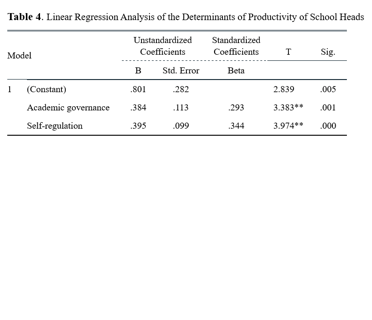
This descriptive-correlational study assessed the levels of academic governance, self-regulation, and productivity among school heads considering their sex, age, civil status, educational attainment, and administrative experience. It also examined the extent to which self-regulation and academic governance influence productivity. The aim was to enhance school heads’ competencies in these key areas. Data for this study were gathered using researcher-developed, expert-validated questionnaires. Descriptive statistics (frequency, percentage, mean, and standard deviation) and inferential test (Linear Regression at a 0.05 significance level) were conducted using SPSS. Findings revealed that school heads exhibited very good levels of academic governance and very high self-regulation. Productivity was also consistently high across 14 indicators. Notably, both self-regulation and academic governance significantly influenced productivity, with self-regulation exerting a stronger effect. Based on the results, a learning and development framework was formulated, encompassing three proposed initiatives: Project CRFL, Project Lead Within, and Project eLead. These initiatives aim to strengthen leadership by fostering emotional intelligence, enhancing collaboration, and cultivating future-focused skills. The study concludes that effective leadership stems more from internal capacities than demographics, highlighting the need for continuous, context-specific training for school heads.
References
Republic Act No. 9155, “Governance of Basic Education Act of 2001,” August 2001, https://www.officialgazette.gov.ph/2001/08/11/republic-act-no-9155/.
Department of Education, “National Adoption and Implementation of the Philippine Professional Standards for School Heads,” DepEd Order No. 24, s. 2020, September 2020, https://www.deped.gov.ph/wp-content/uploads/2020/09/DO_s2020_024-.pdf.
J. B. Alitagtag, “Emotional Intelligence and Leadership Effectiveness of Public Junior High School Heads in the Province of Laguna,” Psychology and Education Journal, vol. 58, no. 5, April 2021, pp.172-177, https://psychologyandeducation.net/pae/index.php/pae/article/view/5151.
E. C. Callo, M. G. Asilo, “School Head’s Professional Identity, Emotional Intelligence and Perfectionism: Three-Tier Factors to Advance Pedagogical Leadership,” International Journal of Multidisciplinary: Applied Business and Education Research, vol. 5, no. 3, March 2024, pp. 949-956, https://doi.org/10.11594/ijmaber.05.03.18.
R. B. Magdaraog, “Influence of Instructional Leadership Practices of School Heads on Teachers’ Motivation and Competence,” United International Journal for Research & Technology, vol. 6, no. 4, February 2025, pp. 10-34, https://uijrt.com/paper/influence-instructional-leadership-practices-school-heads-teachers-motivation-competence.
A. A. S. Ahmed, F. E. Ali, M. M. Taha, “Academic Governance Strategies and Their Impact on the Quality of Educational Performance,” Academy of Strategic Management Journal, vol. 22, no. 1, January 2023, pp. 1-6, https://www.abacademies.org/abstract/academic-governance-strategies-and-their-impact-on-the-quality-of-educational-performance-15602.html.
M. M. Dela Cruz, J. M. Jimenez, “Toward a Participatory University Governance: Model for State Universities and Colleges in the Philippines,” Asian Journal of Educational Research, vol. 3, no. 1, 2015, pp. 26-42, https://www.multidisciplinaryjournals.com/wp-content/uploads/2015/01/TOWARD-A-PARTICIPATORY-UNIVERSITY-GOVERNANCE-Full-Paper.pdf.
E. Dietl, J. Reb, “A Self-Regulation Model of Leader Authenticity Based on Mindful Self-Regulated Attention and Political Skill,” Human Relations, vol. 74, no. 4, November 2019, pp. 473-501, https://doi.org/10.1177/0018726719888260.
B. S. Torrence, S. Connelly, “Emotion Regulation Tendencies and Leadership Performance: An Examination of Cognitive and Behavioral Regulation Strategies,” Frontiers in Psychology, vol. 10, July 2019, https://doi.org/10.3389/fpsyg.2019.01486.
A. Afzal, F. L. Naz, M. H. Nawaz Khan, “Investigating the Role of Emotional Intelligence for Effective Leadership: A Study of School Principals from Urban Settings,” Global Educational Studies Review, vol. 8, no. 2, June 2023, pp. 110-123, https://doi.org/10.31703/gesr.2023(VIII-II).11.
C. G. Sevilla, “Research Methods,” Rex Book Store, Inc.: Quezon City, Philippines, 1992, ISBN: 9789712310584.
J. P. Spillane, “Distributed Leadership, Jossey-Bass: San Francisco, CA, USA, January 2006, ISBN: 978-0787965389.
R. J. Marzano, T. Waters, B. A. McNulty, “School Leadership That Works: From Research to Results,” ASCD: Alexandria, VA, USA, September 2005, ISBN: 978-1416602279.
K. Leithwood, D. Jantzi, “The Effects of Transformational Leadership on Organizational Conditions and Student Engagement,” Journal of Educational Administration, vol. 38, no. 2, May 2000, pp. 112-129, https://doi.org/10.1108/09578230010320064.
J. L. Epstein, “School, Family, and Community Partnerships: Preparing Educators and Improving Schools (2nd ed.),” Routledge: NY, USA, April 2018, https://doi.org/10.4324/9780429494673.
D. C. S. Gil, “Distributed Leadership in Schools: Investigating Leadership Practices Across Educational Settings,” Excellencia: International Multi-disciplinary Journal of Education, vol. 2, no. 10, December 2024, pp. 981-999, https://multijournals.org/index.php/excellencia-imje/article/view/2231.
K. Leithwood, C. Day, P. Sammons, A. Harris, D. Hopkins, “Successful School Leadership: What It Is and How It Influences Pupil Learning,” Research Report 800, University of Nottingham, 2006, https://dera.ioe.ac.uk/6617/2/media-3f6-2b-what-we-know-about-school-leadership-full-report.pdf.
E. Dhuey, J. Smith, “How School Principals Influence Student Learning,” Empirical Economics, vol. 54, no. 1, July 2017, pp. 851-882, https://doi.org/10.1007/s00181-017-1259-9.
National Policy Board for Educational Administration, “Professional Standards for Educational Leaders (PSEL),” 2015, https://www.npbea.org/wp-content/uploads/2017/06/Professional-Standards-for-Educational-Leaders_2015.pdf.
R. M. Alagos, “School Heads’ Innovativeness, Leadership Competence, and Productivity,” IOER International Multidisciplinary Research Journal, vol. 6, no. 4, December 2024, pp. 114-121, https://doi.org/10.54476/ioer-imrj/688319.
E. D. Hale, “School Heads’ Leadership Style, Role Appreciation, and Emotional Intelligence Towards the Level of Productivity,” AIDE Interdisciplinary Research Journal, vol. 3, no. 1, April 2023, pp. 85-108, https://doi.org/10.56648/aide-irj.v3i1.56.
E. K. San Jose Roxas, “The Interplay of School Governance, Resource Management and Participatory Decision-Making for School Performance Optimization,” International Journal of Research Publications, vol. 148, no. 1, May 2024, pp. 292-310, https://doi.org/10.47119/IJRP1001481520246423.
E. B. Dacpano, “The Influence of School Heads’ Transformational Leadership on Schools’ Performance: The Case of City Schools Division of San Fernando, La Union,” International Journal of Multidisciplinary: Applied Business and Education Research, vol. 3, no. 9, September 2022, pp. 1717-1736, https://doi.org/10.11594/IJMABER03.09.12.
Downloads
Published
Issue
Section
Categories
License
Copyright (c) 2025 Mark Francis B. Natividad, Grace C. Pastolero (Author)

This work is licensed under a Creative Commons Attribution-NonCommercial 4.0 International License.